

Science Behind Natural Appetite Suppressants 2026
Table of Contents
- How Appetite Works: Hunger, Cravings, and Fullness
- Do Natural Appetite Suppressants Work?
- Natural Appetite Suppressant Foods That Help You Feel Full
- Natural Supplements for Appetite Control: What the Research Shows
- How to Reduce Hunger Naturally: A Practical Framework
- Safety, Interactions, and Who Should Be Cautious
- What to Ignore: Common Bad Advice About Appetite Suppression
- Frequently Asked Questions
Last Updated: October 17, 2026
How Appetite Works: Hunger, Cravings, and Fullness
The science behind natural appetite suppressants in 2026 starts with a distinction most guides skip: hunger, cravings, and fullness are three separate signals responding to different inputs.
Each signal runs on a different timescale: hunger and fullness meal to meal, cravings on reward circuitry triggered by cues, stress, or habit, and long-term energy balance over days and weeks via fat-tissue signals.
The Gut-Brain Signals That Drive Food Intake
Your gastrointestinal tract releases hormones in response to what you eat, and those hormones talk directly to the brain about energy status and satiety. The main players:
- GLP-1 (glucagon-like peptide-1) is released from the gut after eating and signals fullness while slowing gastric emptying. It is the same pathway targeted by prescription GLP-1 receptor agonists, though natural ingredients support the body's own release rather than delivering an exogenous drug.
- Ghrelin rises before meals and falls after eating, functioning as a hunger cue. It is sometimes called the "hunger hormone" because it tracks anticipated eating rather than stored energy.
- Leptin communicates longer-term energy stores from fat tissue to the brain. It rises with fat mass and falls during weight loss, which helps explain why hunger often increases after weight is lost.
These signals don't act in isolation. A protein- and fiber-rich meal produces a stronger combined GLP-1, PYY, and CCK response than refined starch, so meal composition changes how full you feel at the same calorie level.
The practical takeaway: these signals work through measurable biology rather than willpower, reframing appetite as a system you can support, not a character flaw to overpower.
Do Natural Appetite Suppressants Work?
The honest answer: it depends entirely on which one you mean. "Natural appetite suppressants" covers foods, fibers, herbal ingredients, and formulated supplements, and evidence quality across those categories is wildly uneven.
Natural appetite suppressants are foods, compounds, or supplements intended to reduce hunger or increase fullness through physiological mechanisms rather than medication. That definition is broad enough to include a bowl of lentils and a patented botanical extract, which is exactly why blanket claims about the category are useless.
Grading the Evidence by Ingredient and Study Quality
Here's the framework we use, and the part most roundups get wrong: a single small study is not a body of randomized controlled trials, and a trial on a raw ingredient is not a trial on a finished product.
| Evidence Tier | What It Looks Like | How Much Weight to Give It |
|---|---|---|
| Strong | Multiple randomized controlled trials, consistent outcomes | Reasonable basis for a recommendation |
| Moderate | Human studies with smaller samples or shorter duration | Promising, not settled |
| Preliminary | Single trial or limited replication | Treat as a hypothesis |
| Weak | Mechanistic theory or animal data only | Marketing, not evidence |
A common mistake is treating all human studies as equivalent. Sample size, duration, population, and whether the study measured actual food intake or only subjective ratings all change what a result means.
Natural Appetite Suppressant Foods That Help You Feel Full
Food-based strategies deserve first place: least risk, broadest supporting evidence. No capsule outperforms a consistently structured plate.
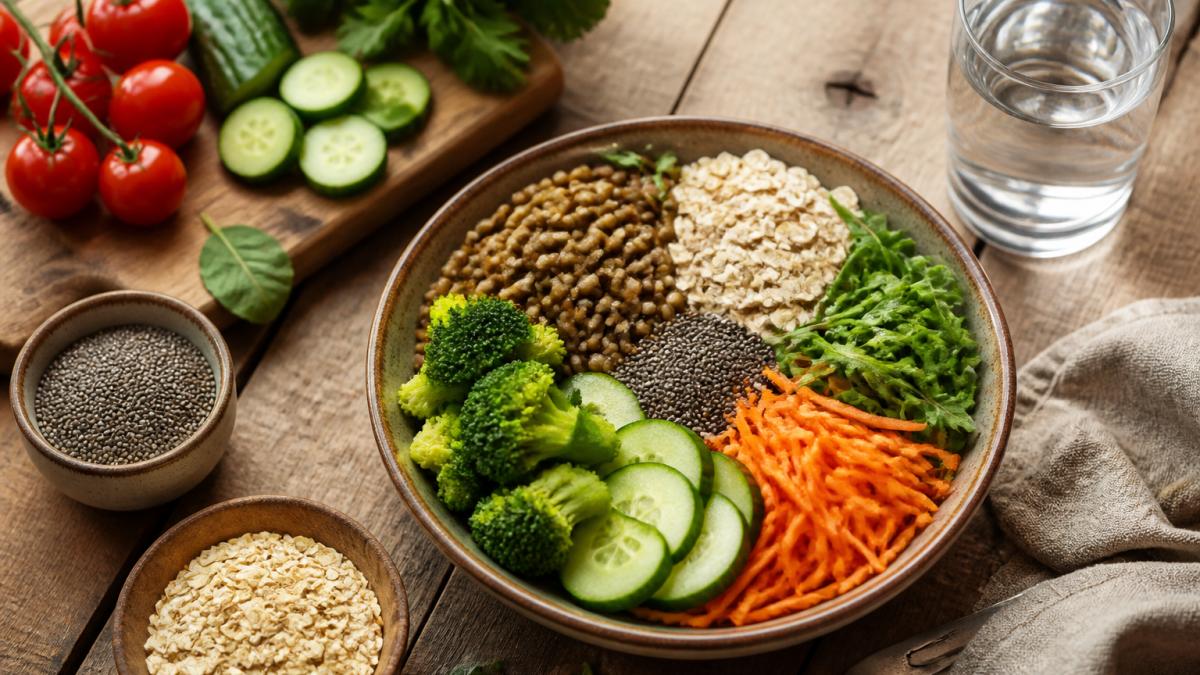
Fiber, Protein, and Water: The Three Anchors
Fiber is the most reliable food lever for fullness: soluble fiber absorbs water and slows gastric emptying.
Protein supports satiety through slower digestion and effects on appetite-regulating hormones, so anchor meals with a protein source rather than treating it as an afterthought.
Water contributes through gastric stretch: stomach volume adds to fullness, making water before a meal a low-cost habit with a plausible mechanical basis.
Natural Supplements for Appetite Control: What the Research Shows
Supplements occupy the widest gap between marketing and evidence. Some ingredients have genuine human trial support; others rest almost entirely on mechanistic theory.
Green tea extract and caffeine are among the more studied options. Caffeine has a modest effect on energy expenditure and thermogenesis, and green tea catechins have been examined for metabolism and body weight.
The ingredient worth examining closely in 2026 is Dyglofit®, a patented West African botanical extract.
Dose, Timing, and Realistic Effect Sizes
Dose is where most supplement advice collapses. A botanical studied at a specific extract concentration and dose tells you nothing about a product using a different preparation at a fraction of the amount.
- Match the studied dose. If the research used a defined extract at a defined amount, a product using less is not the same intervention.
- Timing follows mechanism. Ingredients that slow gastric emptying or support GLP-1 signaling are typically taken before meals, when those signals matter.
- Expect modest, gradual shifts. Realistic outcomes look like eating somewhat less without deliberate restriction, not dramatic transformation in a week.
That's how we formulated Metabolic Rewire: Dyglofit® at the exact dose used in published clinical research, with no stimulants and no synthetic hormones. The Plus version adds citicoline for mental clarity alongside the same appetite-signal support.

How to Reduce Hunger Naturally: A Practical Framework
Reducing hunger naturally is less about one powerful ingredient and more about stacking small, evidence-aligned levers until the cumulative effect changes how much you eat without conscious effort.
- Audit your protein and fiber intake for three days. Most people who report constant hunger are simply under-eating one or both.
- Front-load hydration. Water before meals, and throughout the day rather than in one burst.
- Fix meal timing consistency. Irregular eating patterns make hunger signals harder to read.
- Address sleep. Short sleep reliably disrupts appetite-regulating hormones and increases next-day intake.
- Separate cravings from hunger. If a specific food is calling and a meal isn't, that's a reward signal, not an energy deficit. Behavioral strategies work better there than any capsule.
- Then consider a supplement, chosen on evidence quality and disclosed dosing rather than label claims.
That sequence matters. Supplements work best as an addition to a functioning baseline, not as a replacement for one.
Safety, Interactions, and Who Should Be Cautious
Natural doesn't mean risk-free, and the people most interested in appetite support often take the most medication. A useful safety review separates three questions: who should avoid an ingredient, what it interacts with, and how the product is regulated.
Populations That Warrant Extra Caution
- Pregnancy and breastfeeding. Appetite-suppressant ingredients are generally not studied in pregnant or breastfeeding people; discuss weight goals with an obstetric clinician rather than using supplements.
- History of an eating disorder. Appetite-reducing ingredients can reinforce restriction patterns; anyone with a current or past eating disorder should involve a clinician before using appetite-focused products.
- Adolescents. Appetite and growth are still developing, and weight-management supplements are not appropriate without pediatric guidance.
Ingredient-Specific Cautions
- Caffeine and green tea extract. Caffeine tolerance develops quickly, and high-dose green tea extract has been associated with liver-related concerns in some reports, so dose and product quality matter.
- Fenugreek. Human trials exist, but results are not uniform, and it can interact with diabetes medication.
- Chromium. Findings on weight and glucose are inconsistent, and it warrants caution in people managing blood sugar.
Regulatory Context and Label Limits
Dietary supplements in the United States are regulated differently from drugs. The manufacturer is responsible for the accuracy of label claims and for ensuring a product is safe, but pre-market approval is not required. Guidance from the U.S. Food and Drug Administration on dietary supplements is worth reading before you buy anything in this category, because it explains what the framework does and does not guarantee.
What to Ignore: Common Bad Advice About Appetite Suppression
"This supplement works like the injections." It doesn't.
"Detox teas and cleanses reset your appetite." No mechanism resets appetite signaling via a cleanse.
"If it's natural, there are no side effects." Dose-dependent effects exist across the botanical category, and interactions with medication are real.
"One ingredient is the answer." Appetite is a multi-signal system. Anyone selling a single lever as the whole solution is selling, not explaining.
For grounding on the biology, the National Institute of Diabetes and Digestive and Kidney Diseases on weight management is a more useful reference than most supplement marketing pages, and the National Center for Complementary and Integrative Health maintains plain-language summaries of what the evidence actually shows for common herbal ingredients.
Appetite is a signaling system, and the most effective approach in 2026 is the least dramatic: fix the food and behavioral fundamentals, grade every ingredient by evidence quality and disclosed dose, then add targeted support. ROOTSOPHY's Metabolic Rewire uses Dyglofit® at the clinically studied dose to support natural GLP-1 response and appetite control, while Metabolic Rewire Plus pairs the same ingredient with citicoline for mental clarity.

Frequently Asked Questions
Do natural appetite suppressants actually work?
Some do, but the effect sizes are modest and depend on the ingredient. Fiber and protein have the strongest human evidence for increasing fullness and reducing calorie intake. Herbal options like green tea extract and fenugreek show smaller, less consistent effects. The key is matching expectations to the research: natural appetite suppressants can support portion control, but they are not a substitute for a structured eating plan or medical treatment for obesity.
Which natural supplements for appetite control have the strongest scientific evidence?
Soluble fiber such as glucomannan and psyllium has the most consistent randomized controlled trial support for fullness and reduced food intake. Protein and green tea extract also have reasonable human data, though effects are smaller. Fenugreek and chromium have mixed results. Study quality varies widely, so look for ingredients tested in randomized controlled trials on human participants, at the same dose used in the product, rather than relying on animal or cell studies.
Are natural appetite suppressant supplements safe?
Most food-based ingredients are generally well tolerated, but natural does not mean risk-free. Fiber supplements can cause bloating and interfere with medication absorption if taken at the same time. Green tea extract in high doses has been linked to liver injury in rare cases. Herbal ingredients can interact with blood pressure, thyroid, and diabetes medications. Check with a pharmacist or physician before starting any supplement, especially if you take prescription medication or have a chronic condition.
How can you reduce hunger naturally without supplements?
Start with protein at every meal, aim for 25 to 30 grams of fiber daily, and drink water before meals to support gastric stretch. Eat slowly and prioritize whole foods over ultra-processed options, which are engineered to override fullness signals. Sleep and stress management matter too, since poor sleep raises ghrelin, the hunger hormone. These food-based strategies are the foundation, and supplements work best alongside them rather than instead of them.
How do appetite, cravings, and food noise differ?
Hunger is a physical need driven by hormones like ghrelin and signals from the gut. Cravings are specific urges for particular foods, often tied to reward pathways and emotional cues. Food noise refers to persistent, intrusive thoughts about eating that continue even when you are not physically hungry. The distinction matters because each responds to different strategies: hunger responds to protein, fiber, and volume, while cravings and food noise often need behavioral and environmental changes.
How long does it take for natural appetite suppressants to show results?
Fiber and protein affect fullness within a single meal, so you may notice reduced hunger right away. Herbal supplements and botanical extracts typically need two to four weeks of consistent use before effects on appetite and food intake become noticeable. Weight change is slower, often measured over eight to twelve weeks in clinical trials. Anyone promising rapid results in days is overselling what these ingredients can do.
